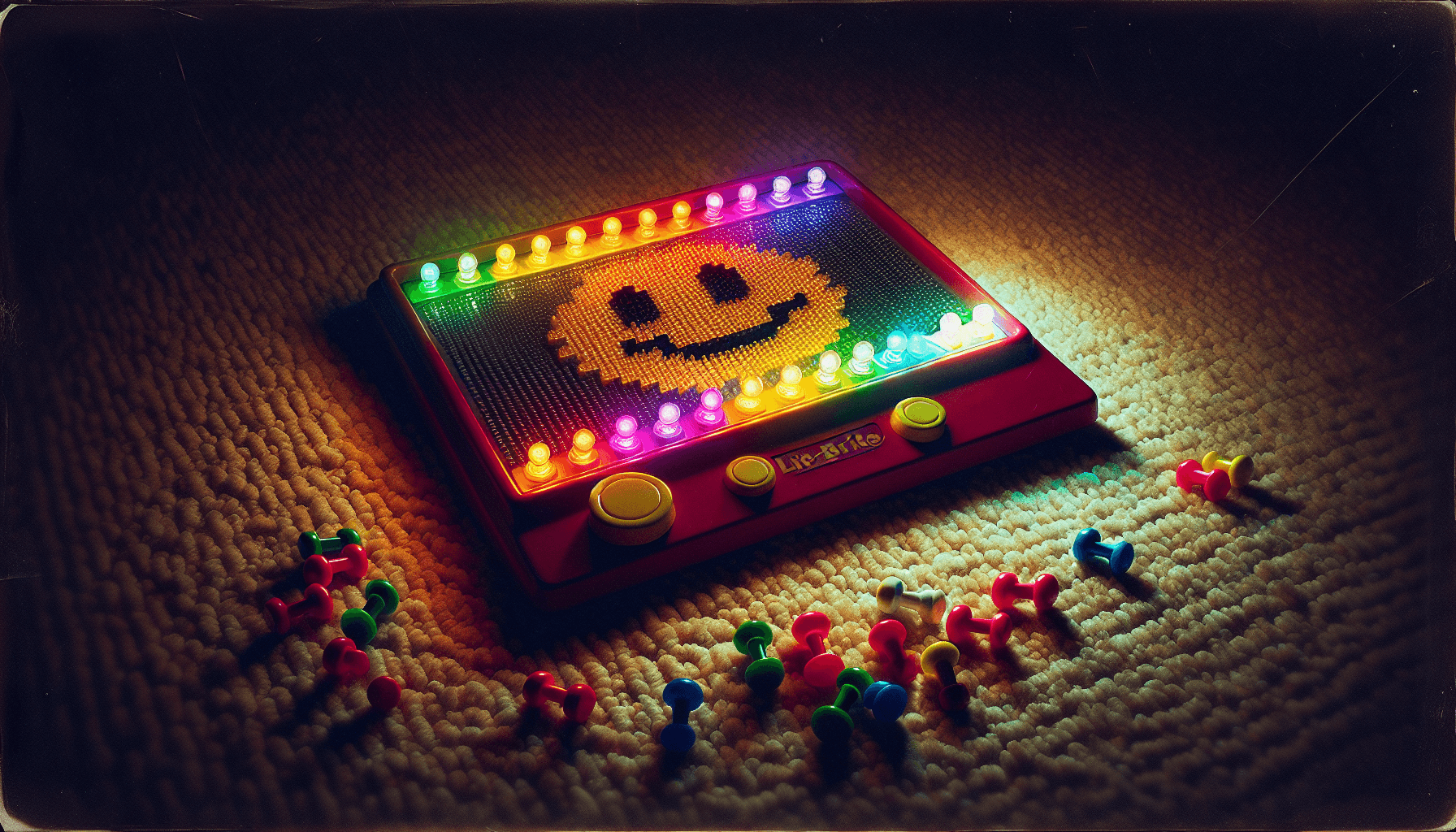
The first thing you did was push a peg through the paper, and the paper made a small sound. A quick snk. The peg punched through, met the hole in the black plastic underneath, and seated itself with a tiny click you could feel in your fingertips before you heard it. Then you reached for the next peg, and the next, and you did this for forty-five minutes, and at the end you turned off the lamp and flipped the switch and a clown's face glowed at you in eight colors out of a dark living room.
The Lite-Brite was a pixel display. We didn't have the words for that yet. We just knew it was magic.
The Bulb
There was one bulb. Twenty-five watts. A regular incandescent screwed into a socket inside a rectangular plastic case that, in any other context, would have looked like a small briefcase or a piece of cheap kitchen equipment. The bulb pointed forward at a black peg-board, and the peg-board had something like four hundred holes drilled in a staggered grid. You pushed translucent plastic pegs through the holes, and the bulb shone through the pegs, and that was it. That was the entire mechanism.
A 25-watt bulb. Eight colors of plastic. A piece of black paper with X's printed on it telling you which color went where. That was the toy. It wasn't networked. It didn't make a sound. There were no batteries. You just plugged it into the wall like a desk lamp and stared at it.
This was, by any measure, an absurd thing for a child to spend an entire weekend on.
A 25-watt bulb. Eight colors of plastic. A piece of black paper with X's printed on it. That was the toy.
The Templates
The pack came with templates. Black paper sheets, perforated for the holes, with a small letter at every position telling you what color peg went there. R for red. B for blue. Y for yellow. The templates had names like Sailboat and Clown and Castle and Hot Air Balloon, and they were printed in a slightly washed-out way that suggested the designers had not been thrilled about this part of the job.
Following the template was the point. You followed the template. You read the letters. You picked up the corresponding peg. You pushed it through. You did this several hundred times. At the end, when you turned on the bulb, you had made the exact same Sailboat that every other kid in America had made that month, and you would feel a small, real, slightly embarrassed pride about it.
Some kids ignored the templates. Some kids stabbed pegs through the black paper at random and called it art. Their Lite-Brites looked like static. Their Lite-Brites looked like a TV tuned to a dead channel, except in eight colors. Their Lite-Brites were, honestly, sort of cooler than yours, but you didn't say that, because you had spent two hours on the Sailboat.
The Pegs
There were always more pegs than you needed and always fewer pegs than the template asked for.
The pegs came in a little plastic compartment in the lid of the box. They were tiny. Each one was about the size of a Tic Tac, with a faceted top that caught the light and a slightly tapered shaft that fit through the holes. They were translucent in the way a fruit-flavored Lifesaver is translucent. They picked up color from the bulb behind them and held it.
You needed a lot of red pegs to fill in a Hot Air Balloon. You did not have a lot of red pegs. You had a lot of yellow pegs, because nobody had ever made a template that needed eighty yellow pegs, but the manufacturer had stocked the box like nobody was paying attention. You'd be twenty minutes into the Castle and run out of green and have to start improvising. The Castle would have a blue moat. The Castle would have a red flag. The flag would not match the template. The flag would be wrong. The flag would haunt you.
What Happened to the Pegs
Here is what happened to the pegs. They fell.
You'd pick up a fistful, you'd be sorting through them looking for the right color, and three would slip through your fingers and bounce. They would bounce forever. Lite-Brite pegs had a coefficient of restitution that rivaled a superball - they would hit the carpet and skitter under the couch, ricochet off the baseboard, end up in the hallway, end up in the kitchen, end up in the heating vent. You could hear them rolling for a long time after you'd dropped them, a little plastic tk tk tk sound moving away from you.
You'd lose two or three every session. By the end of the first week, you were short on red. By the end of the first month, you were short on everything. By summer, the box of pegs was two-thirds the size it started, and the difference was not gone - it was distributed. It was in the carpet. It was under the couch. It was between the cushions. Your dad, vacuuming, would hear the unmistakable rattle of a Lite-Brite peg going up the hose, and he would say nothing, because the alternative was unscrewing the vacuum cleaner.
I am telling you, with confidence, that there are still Lite-Brite pegs in the carpet of your childhood home. They migrated there in 1994 and they have not moved.
- Under the couch - 40%
- Inside the heating vent - 15%
- Vacuum cleaner bag - 12%
- Between the cushions - 10%
- Bottom of the toy box, found in 2008 - 8%
- Stepped on barefoot at 2 a.m. - 8%
- Dog ate it - 5%
- Truly, eternally lost - 2%
The Ritual
The Lite-Brite was a thing you did at night. It was a thing you did with the overhead off and the lamp off and just the bulb of the toy itself glowing through a clown's face into the room. The whole point was the dark. In daylight, with the room lit, the glow was washed out and the colors looked muddy. You'd squint at it and think that's it? You'd flip the lights off and the same image would come back as if from a different toy. The Sailboat would ignite.
This was, again, kind of remarkable. You were five or six or eight years old and you were already understanding, on some pre-verbal level, that some things are only beautiful when you control the light around them. You were already curating an experience. You were getting your siblings to leave the room and your mom to wait a second, and then unveiling a glowing rectangle and saying look. You were doing color theory. You were doing display engineering. You were doing it badly, in the way kids do everything badly, but you were doing it.
You were five or six or eight and you were already understanding, on some pre-verbal level, that some things are only beautiful when you control the light around them.
The Hot Bulb Problem
The bulb got hot.
This was not, in the early '90s, a major safety concern. The bulb sat inside a plastic case with vents on the back, and the back of a Lite-Brite was always slightly warm to the touch in a way that, today, would result in a recall, a class action, and a redesign. You'd reach behind it to plug it in and feel that unmistakable I am inside an appliance warmth. You'd sometimes leave it on for an hour and then touch the back and say ow in a quiet, surprised way, and you'd never tell your mom about it.
The pegs, also, got hot. Not dangerously so, but warm. You'd pull a peg out of the board after a long session and it would have absorbed enough heat from the bulb to feel slightly alive in your hand. That was nice, actually. Like the peg had been working.
The Templates as Curriculum
I want to come back to the templates for a second.
The templates were doing something subtle. They were teaching a child to convert a picture into pixels, before any child had a reason to know what a pixel was. The image was already abstracted. The clown was already broken into a grid of color values. You were a tiny, low-paid graphics card. You were rendering. The template was a bitmap. You were the renderer. The bulb was the monitor.
This is, in hindsight, the same logic as cross-stitch, paint-by-number, or beadwork. The logic of any craft where someone smarter than you has decomposed an image into instructions, and your job is to execute the instructions in physical media. Lite-Brite was paint-by-number where the paint glowed. Lite-Brite was cross-stitch where you didn't need a needle. Lite-Brite was the first time most of us made a picture by following coordinates.
There is a not-very-charitable read of this, which is that the toy was a kit and you were assembling it. There is a more charitable read, which is that the kit was a pretext - it was the thing that got you to spend ninety minutes pushing tiny plastic objects through holes, after which the lights went off and the room glowed and you felt, briefly, like a small wizard. Both reads are correct. The toy did not seem to mind being either thing.
The Black Paper Was Single-Use
The templates had one life.
Each peg punched a hole in the paper. Once you'd pushed three hundred pegs through a Sailboat template, the Sailboat template was a Sailboat template with three hundred holes in it. You couldn't really re-use it - the holes told you nothing about the colors, and the letters had been on the front, and the front was now mostly hole. So you did the Sailboat once. Then you moved to the Castle. Then the Hot Air Balloon. Then you ran out of templates and you were left with the blank black paper that had come at the back of the pack, which was for making your own designs, which you had been delaying because you knew it would be a disaster.
The blank paper was the moment of truth. No letters. No grid. Just a black rectangle and a child with diminishing pegs and a 25-watt bulb. Most kids did a heart. Some kids did their initials. A few kids attempted a freehand portrait of their dog and produced something that looked like a sunset over a garbage fire. The blank paper was where you found out whether the Lite-Brite had taught you anything, and the answer was usually not really, no.
The Lite-Brite Still Exists
You can buy one right now. They make a "Magic Screen" version with LEDs and rechargeable pegs and patterns that pulse. It's fine. It's not the same. The magic of the original was that it was almost nothing - a bulb, a board, some plastic - and it produced something that, for a moment, in the right light, looked like it had been made by something more sophisticated than a child sitting on a carpet for two hours.
The new ones are sophisticated. The original was sophisticated only in the kid using it.
What I Made
I'm trying to remember what I made. I had a Lite-Brite. I know I had it. I remember the box. I remember the lid with the little compartment for the pegs. I remember running out of red.
I cannot remember a single thing I made on it.
That's the thing about the toy, in retrospect. The output didn't matter. The output was, by design, ephemeral - the moment the bulb went off, the picture was gone, and the moment you pulled the pegs out, the picture was gone forever. You couldn't save your work. You couldn't show anyone tomorrow. The Lite-Brite was a series of one-night stands with light. You made a clown. You looked at the clown. You went to bed. The next morning the clown was a piece of black paper with holes in it, the pegs were back in the compartment, one was missing, the bulb was cold, and the toy was waiting.
Somewhere in the carpet of the house I grew up in, there is a yellow peg I dropped in 1993. I have decided this is true. I cannot prove it. The house has new owners now. The carpet has been replaced twice. The peg either went with the carpet or, more likely, slipped between the seams and made a home under the subfloor, where I like to imagine someone is going to find it during a renovation in 2042 and not know what it is. The toy whose whole point was that nothing it made would last has, in this one accidental way, produced the most permanent thing in the room.