My dad recorded the greeting on our answering machine at least fifteen times on a single Sunday afternoon in 1994. I know this because I was sitting at the kitchen table doing homework and had to listen to every single take. He'd hit record, clear his throat, start talking, then stop halfway through and say "no, that sounded weird" and rewind the tape. My mom was leaning against the counter with her arms crossed, waiting for him to finish so she could add her part. The dog kept barking. Nobody was getting their part right. It was the most collaborative and least efficient creative project our family ever undertook.
And we were not special. Every family in America was doing this.
The Machine Itself
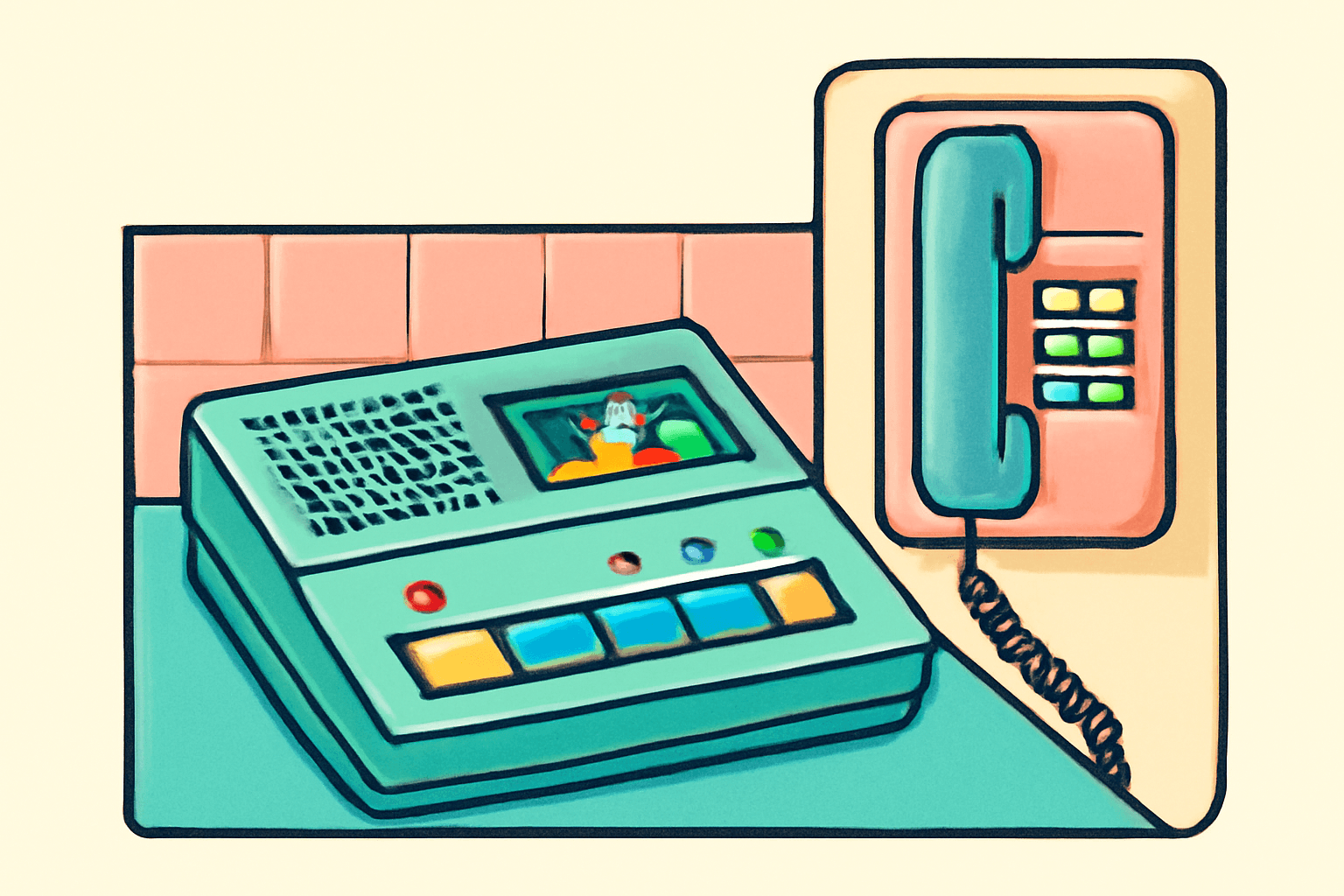
Before we talk about the greeting, we should talk about the object. The answering machine was a physical thing that sat on a table or a counter, usually near the kitchen phone, usually beige or gray, with a small speaker and two little cassette tapes inside it. One tape was the outgoing message - your greeting. The other tape recorded incoming messages. These were micro-cassettes, tiny things barely bigger than a postage stamp, and they held maybe thirty minutes of audio if you were lucky.
The machine had actual buttons you pressed. Play. Stop. Rewind. Fast Forward. Delete. And a little counter that told you how many messages you had. But the real interface - the thing that defined the entire emotional experience of the answering machine - was the blinking red light.
You'd come home from school, drop your backpack by the door, and look at the machine. If the light was solid, nothing. Nobody called. Nobody thought of you. But if it was blinking - blinking - that meant someone had left a message. And the number of blinks told you how many. Two blinks. Pause. Two blinks. Pause. That's two messages. Your heart would do a little thing.
The blinking red light on the answering machine was the original notification badge - except it actually meant something, because people didn't leave messages unless they had something to say.
You'd hit play, and the tape would whir, and a tiny speaker would broadcast the messages into the room for anyone within earshot. There was no privacy. If your crush called and left a message, your entire family heard it. If the dentist called about your cavity, that was public information now. The answering machine did not believe in secrets.
The Production
But the greeting. The outgoing message. That was where families became unwitting performance troupes.
There was always a negotiation. Dad wanted to be funny. He wanted to do a bit. Maybe a fake detective voice. Maybe a joke about how "we're out solving crimes" or "you've reached the Hendersons, we're not home but our refrigerator is running - you'd better go catch it." Dad thought this was hilarious. Dad was wrong.
Mom wanted it professional. Short, clear, informative. "You've reached the Henderson residence. We're unable to come to the phone right now. Please leave a message after the tone." Mom understood that the pediatrician might be calling back and did not need to hear dad's comedy routine.
And then there was the kid. Every household with children between the ages of four and nine had at least one child who insisted on saying something on the greeting. Usually their name. Usually in a voice so quiet or so loud that it didn't match anything else on the recording. "And TYLER!" shouted into the receiver at a volume that suggested Tyler had been waiting his whole life for this moment.
The Five Archetypes of Family Answering Machine Greetings:
- The Dad Show - dad doing ninety percent of the talking in a voice he doesn't normally use
- The Round Robin - each family member says one line, like a hostage video but festive
- The Mom Override - mom recorded it herself while everyone was at school because she was tired of dad's nonsense
- The Singing Greeting - set to a popular song, never on key, always too long
- The Kid Takeover - a seven-year-old recorded over the greeting while nobody was watching
The round robin was the classic format. Dad goes first because dad is holding the machine. Mom goes second because mom is standing next to him. Then each kid in descending age order, each one saying their name or "we can't come to the phone right now" or whatever line they'd been assigned. And then all together at the end: "Leave a message after the beep!" In theory it was charming. In practice it took forty-five minutes and someone always messed up their line.
The Takes
Nobody ever got it on the first try. Or the fifth. The dog would bark right in the middle of mom's sentence. Someone would start laughing. The youngest kid would say the wrong thing. Dad would flub his joke. You'd play it back and someone's voice would sound weird and they'd insist on doing it again. The micro-cassette tape would get rewound so many times you worried it would break.
It was, without exaggeration, the closest most American families in the 90s ever came to a group creative project. Thanksgiving dinner was collaborative cooking. The answering machine greeting was collaborative art. Everyone had a vision. Nobody agreed on the vision. The final product was always a compromise that satisfied no one and charmed everyone who heard it.
Recording the family answering machine greeting was the only time all year your household functioned as an ensemble cast - and like most ensemble casts, everyone thought they should have more lines.
And the greeting stayed. Once you finally got a take that was acceptable - not perfect, just acceptable, because perfection was never achievable with a six-year-old and a golden retriever in the room - that greeting lived on the machine for months. Sometimes years. You'd grow up. Your voice would change. But the greeting would still have you at age eight saying "and Matthew!" in a squeaky voice that your friends would hear every time they called and you weren't home.
Screening
The answering machine didn't just take messages. It was a surveillance tool.
When someone called and nobody picked up, the machine would answer, play the greeting, and then start recording. But here's the thing - you could hear the person leaving the message through the speaker in real time. The machine was broadcasting it into the room. So you could stand there, listening, deciding whether this particular caller was worth picking up for.
"Hi, this is Carol from Dr. Mitchell's office, we're just calling to confirm your appointment on Thurs -"
Nobody moved.
"Hey, it's me, are you guys there? Pick up if you're there."
Mom would look at the caller, consider it, sometimes pick up mid-message. "Hello? Yeah, I'm here, I was just - " and then some lie about being in the other room. You were not in the other room. You were standing right there, three feet from the machine, screening.
This was completely normal behavior. Everybody screened. It was the original "let it go to voicemail," except you were actively listening to the person talk in real time and making a conscious choice to ignore them. It was intimate and ruthless at the same time.
The Prank
At some point, every kid in America discovered that you could record over the greeting. Just hit the record button on the outgoing message tape and say whatever you wanted. Your parents' carefully negotiated family greeting - the one that took an entire Sunday afternoon to produce - could be replaced in five seconds by a twelve-year-old doing a Beavis and Butt-Head impression.
Some kids did this on purpose as a joke. Some did it by accident while messing with the machine's buttons. Either way, the result was the same: your parents' boss or your grandmother would call the house and hear "uhhh huh huh huh, leave a message, huh huh" and there would be consequences.
The answering machine prank was a high-risk, low-reward crime. The payoff was maybe two hours of your dumb greeting being out there before someone noticed. The punishment was swift and severe. But kids did it anyway, because the machine was right there and the temptation was impossible to resist.
The Transition
The digital answering machines came later and killed some of the magic. No more tapes. No more rewinding. The greeting was stored on a chip and the messages were stored on a chip and everything was cleaner and more efficient and less interesting. You couldn't hold the tape in your hand anymore. You couldn't accidentally record over someone's message by letting the tape run too long.
And then voicemail happened and the machine disappeared entirely. The phone company just... handled it. Your greeting was recorded into a system somewhere, stored on a server, and callers heard it through the network instead of through a tiny speaker on your kitchen counter. There was no blinking red light. There was no gathering around the machine to listen together. You checked your voicemail privately, on your own phone, and deleted messages one by one in silence.
It was better in every technical way. And it lost something that I don't think we even noticed losing at the time.
The answering machine was the last piece of household technology that required the whole family to agree on something - even if the agreement was just "fine, the dog can bark, we're keeping this take."
What the Tape Held
Somewhere in a box in my parents' garage - or more likely in a landfill somewhere in central New Jersey - there's a micro-cassette tape with our family's answering machine greeting on it. My dad doing his best announcer voice. My mom keeping it together. Me saying my name too fast. My little brother saying "bye-bye" even though nobody asked him to say bye-bye. The dog losing her mind in the background.
Nobody saved those tapes on purpose. Why would you? It was just the outgoing message. It wasn't important.
Except that it was all of us, in one room, trying to sound like a family. Which is what we were. Which is maybe what that greeting was actually for - not for the callers, but for us. A tiny recording that said: these are the people who live here, and they showed up at the same time, and they tried to get it right.
They never quite did. That was the best part.